
Coffee Ideas | Marc's Pepper (100g)   | Rs.150.00 |  |
| Marc's peppers are grown naturally in Coorg, under the shade of jungle trees. Coffee plantations are the ideal habitat for pepper cultivation in India. Pepper vines are creepers that grow straight on timber trees like Silver Oak. This traditional variety of pepper is very rare, having a unique lemon- floral aroma and a mild spicy edge . The size of the peppercorns are almost double the size of ordinary peppercorns. Have a look at the process of drying the pepper under the sun. This was an amazing experience!          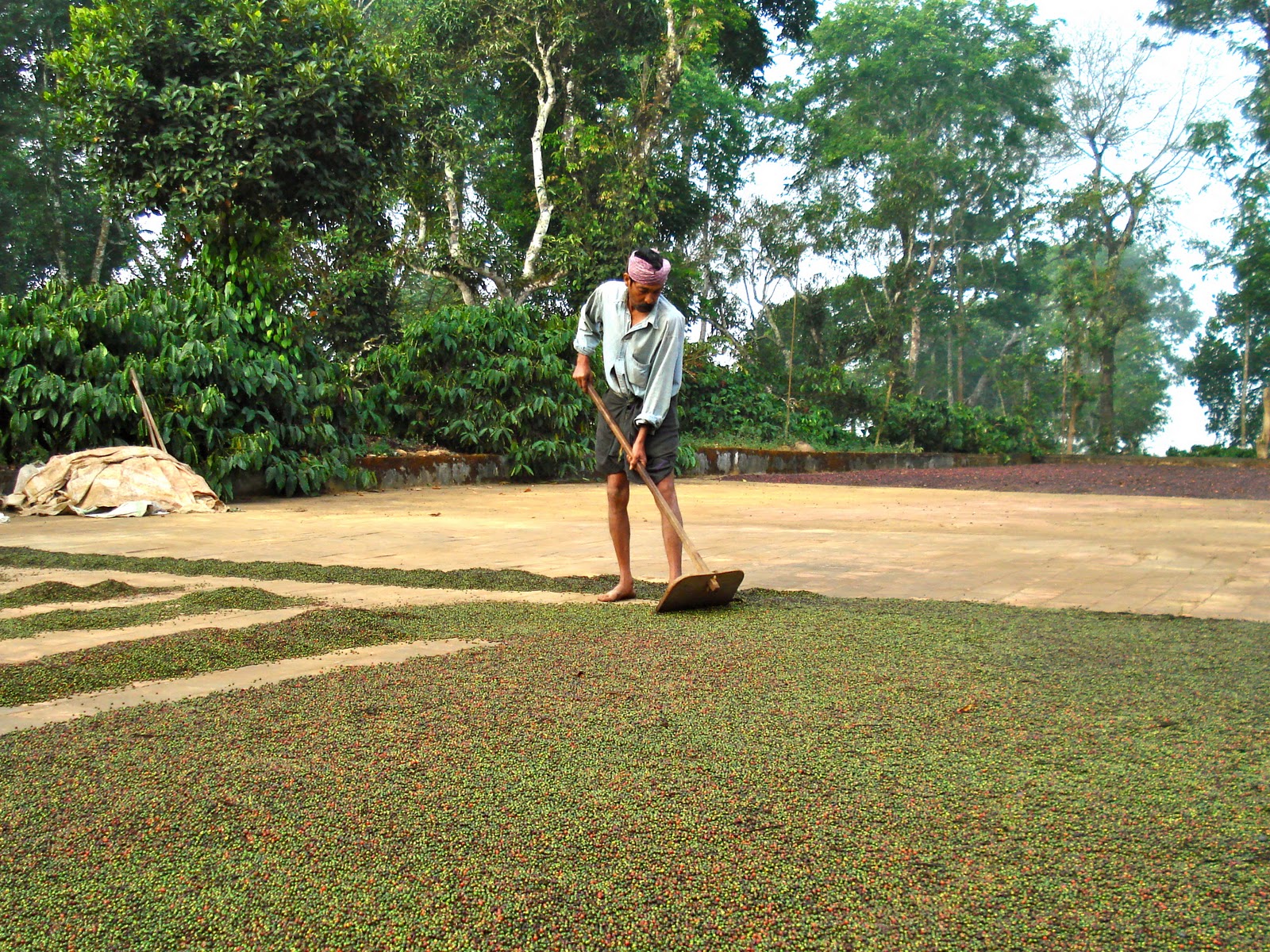      | |||
Thursday, 19 June 2008
Coffee Ideas! Single Estate Pepper


Jaivik Greens Coffee roasted by Coffee Ideas!

Coffee Ideas! is working in collaboration with Jaivik Greens Organic Coffee Farm.
The Plantation is located in Coorg, at 1400 mts ASL. The main crop is arabica Selection 9 inter cropped with Robusta coffee, vanilla, pepper, citrus trees.
The Coffee berries are hand picked when ripe, then pulped, washed and carefully fermented.
Sun dried to remove the moisture up to the desirable levels. Curing and grading is made in Coorg.
The coffee is packed in jute bags by grade and sent to Coffee Ideas! roasting center in Auroville, Tamil Nadu.
Coffee Ideas! roast the coffee with a Probat roaster. Some of the coffee is sold in beans to cafes, restaurants and hotels in 1 kg alluminium pouch with a one way valve. The aroma of the coffee is preserved for 6 months. Other coffee is sold in powder in 250gr and 500 gr in kraft paper bags for the local market

From Left to Right:
Tippu owner of Jaivik Greens
Marc founder of Coffee Ideas!
Ernest founder of Alma de cafe, Spain


Cafe La Terrace, Auroville

Café La Terrace is located on the top roof of the Solar Kitchen, Auroville.
It was re-opened on
Social Hub

Cafés have been social platforms since centuries where people could gather the collective
intelligence of their communities.
It can be said that cafes were the first information hubs before the invention of the world wide web. That is why the first internet outlets were located in cafes and this synergy has become rapidly a global trend.
“At café la Terrace people come to browse into the cyberspace, to socialize and share experiences with others while sipping great organic coffees and healthy food”
Nutrition
There is a lot of thinking before we design our menus and cook the recipes. The idea is to prepare delicious recipes using quality produce that are not only healthy for our body but to the environment as well while producing them. Special care is taken to outsource products supplied by Auroville farms or other nearby organic sources keeping the food miles as low as possible.
“Eat local, feel global“

Our Team
“Feeling part of the Auroville adventure in a creative way through our work”
Most of our team is formed by Aurovilians, Newcomers, Long term guest and Students from different nationalities and social backgrounds. Sharing our common values align us to work together harmoniously in a caring and welcoming atmosphere.
Do you want to joint the team, send an application to: laterrace@auroville.org.in
Articulo escrito por Maria Usuariz, publicado por el diario de Pamplona
POR FIN……………………..un café integral
Por fin se abrió La Terrace.
Por fin Auroville vuelve a disponer de un espacio multi.
Un lugar flexible donde la gente pueda reunirse, compartir su tiempo y experiencias; conocer nuevas perspectivas; y lo mejor de todo, degustar un maravilloso café y una sabrosa comida.
Hay diversos puntos a destacar y redescubrir en este nuevo concepto de cafetería que animaron a Marc Tormo (un valenciano de 36 años) a lanzarse de lleno en este proyecto que él mismo ya comenzó nueve años atrás.
La Terrace es un servicio para la comunidad de Auroville. Se quiere servir una comida lo más sana posible, cultivada, producida y procesada dentro de Auroville.
¨Del campo, al comedor¨ así podríamos resumir esta idea que en el mundo anglosajón se denomina farm & fork (granja & tenedor). Procurar que la comida viaje lo menos posible, considerando de esta manera nuestro entorno, respetándolo y cuidándolo.
Las ensaladas son festivales de formas, texturas y colores sazonadas con salsas aromatizadas con albahaca, eneldo y especias.
Las tortilla de patatas con broccoli y pimientos servida con “pa amb tomaquet” vuela de las manos junto con las pastas frescas y los crepes de champiñones.
Para acompañar estas delicias culinarias y apagar la sed los zumos naturales de papaya, sandia, leche de coco y naranja ofrecen un refrescante complemento .
Y para acabar este viaje gastronómico con un gusto dulzón los pasteles integrales de banana y nueces, chocolate y jengibre actúan como perfectos anfitriones para el producto estrella de La Terrace....el café
New image for Le cafe, a Coffee Ideas! project

 Le Café at the beach offers a unique Pondicherry experience. Coffee and Culture have being always played and important role in our society. The Pondicherry Tourism Development Council ( PTDC) in collaboration with Coffee Ideas! and INTACH, have been working with the renovation and re-organization of le Café and opened it doors on the 28th of November 2008.
LE CAFE new spirit aims at preserving the Heritage of the building, selling tourist tours, offering information about Tourism and Cultural activities and serving a wide range of international and local beverages and food, being the coffee the core product.
Le Café a bridge between the past and the present Historical background
 The Le Café building on the Goubert Salai is one of the oldest buildings of Pondicherry. It is now about 200 years old, even though it was disfigured beyond recognition by a number of recent extensions in the 1990s.
During the French period, this building was Pondicherry's harbour office. It was the first site the Europeans saw as they approached Pondicherry by sea. The harbour captain and his staff worked here. It was also the oldest post office of the city.
For the French, the small structure on the sea front on Goubert Salai may remain an anecdote, but surely not for many fishermen living in Kuruchikuppam. Their ancestors, the "Macouas" (a French deformation of Makuvan), had waited at this site the whole day for some work in one of the hundred "chelingues" of the port of Pondicherry.
It is often quoted as being built in the "beginning" of the 19th Century, because most people think that it was founded around 1827, when Governor Desbassyns de Richemont opened the "Cours Chabrol", known today as "Goubert Salai". But it is now clear that the harbour office is older than that because the French archives in Aix en Provence (CAOM) have another story to tell. When the Cours Chabrol was opened, the same "bureau du port" existed already, "needing a few repairs". And, in 1817, when the French came back to power after the British occupation of Pondicherry, they found a building, which they had to repaint and whose proportions were quite similar to those of today. So the "bureau du port" was never destroyed or rebuilt by the French during the 19th Century.
We know quite well how the site existed in the 18th Century since we find its description in M. Jean Deloche's "Old Pondicherry revisited": There were two buildings known as custom house and harbour office, separated by the "Porte Marine" in 1765. But they were quite different from our "Le Café". In 1793, the British conquered the city once more after a violent bombing. We may assume that the two buildings near the "Porte Marine" were destroyed at that moment, because they were very close to the fortification's walls. As the British needed a harbour office, they had to build a new one. So the "Le Café" is most probably the only witness of the British period of Pondicherry and dates either from the last decade of the 18th Century or the first one of the 19th Century.
We don't know much about the early years of the “Le Café”; but from its plans, we can make out that the two rooms inside were built first. Later, in 1817, the French added two rows of arcades outside: one in the North and one in the East.
When Governor Desbassyn de Richmont visited the site in 1827, he found it in such a bad shape that he decided to rebuild the eastern row of arcades and to create a new one in the South, so as to harmonise the building with the newly opened "Cours Chabrol." It remained unchanged from 1827 to the late 1940s. At that time, the government decided to give the harbour office a modern look: some doors and windows were shuttered, the huge word "Pondichéry" was painted on the eastern wall, "Port" on the western wall. The building began to change only when the port was shifted from "Cours Chabrol" in the late 1960s.
For Pondicherry, this building is a bridge between the past and the present: Now it has been given a new lease of life by the Government by restoring it. If all the uncared heritage buildings can be similarly restored our city will become truly beautiful...
--------------------------------------------
Adapted from an article by RAPHAEL MALANGIN, INTACH
MENU South Indian Organic coffees
Espresso: the essence of coffee made with organic Indian coffee.
Espresso Americano: coffee mug with steaming mild coffee.
Café au lait: French favorite coffee drink. (Mild milk coffee served in a coffee mug)
Cappuccino: Italian famous coffee drink. (Very creamy milk coffee with cocoa powder)
Caffe Latte: large coffee mug with strong coffee and creamy milk
Café Cortado: small coffee with steamed milk, Spanish favorite coffee recipe
Moccaccino: espresso, chocolate syrup, frothed milk and cocoa powder:
Latte Macchiatto: a 3 colored milk coffee served in a glass.
Caffe Affogato: espresso coffee with vanilla ice cream:
Cold Coffee: chilled espresso coffee and milk shake served with chocolate syrup and cocoa powder
Caffè Frappé : a coffee shake with out milk.
Organic Teas, Ayurvedic Herbals and Tissanes
Breakfast tea: organic Ceylon black tea with a complete body and invigorating fragrance, served with a cloud of milk or slice of lemon.
Earl Grey Tea: organic Ceylon tea aromatized with Bergamot. A classic tea either in the morning or afternoon.
Masala Chai: organic Black tea brewed with aromatic hot masala milk.
Black tea: organic Nilgiris tea. Served with a cloud of milk or a slice of lemon.
Green Tea: organic Nilgiris green tea with a delicate aroma and taste.
Tisanes (caffeine free) : a choice of cinnamon, mint, ginger, lemon, chamomile or saffron.
Ayurvedic Herbals : different blend of herbs and spices following Ayurvedic principles Vatha ( invigorating ), Pitha ( energizing) and Kapha ( relaxing) . Preferably served without milk.
Lemon Iced tea: organic Nilgiris Tea with pure lime juice, very refreshing.
Kambucha Iced tea: Organic Nilgiris Tea prepared in a ancient Chinese method.
Beverages
Fresh juices: ( pineapple, sweet lime, grape, orange)
Lassi: ( plain, sweet, banana, fruits):
Lemonade:
Lime soda
Hibiscus soda: soda with hibiscus syrup
Power juice: cold water with hibiscus flower syrup with lime juice
Radha juice: water with Radha’s flower syrup with lime juice
Pineapple champ:
Hot Chocolate: homemade chocolate preparation, steaming and invigorating.
Cold Chocolate: : homemade chocolate preparation, kids favoutite.
Milk shakes : of your choice (Vanilla, Banana, Chocolate, Coffee).
Snacks & Pastries
Samosa: 4 cocktail crispy samosa served.
Vadai: 2 vadai served with tomato and mint chutney.
French Fries
Vegetable Puff
Egg Puff:
Chicken Puff:
French Croissant
Almond Crosissant:
Cheese Croissant
Pain au Chocolat:
Pain au Pomme:
Cakes
Madelaine: flavoured with cinnamon and lemon zest
Apple tartlet: apple compote with nuts served in individual tartlets.
Cheese Cake: creamy and soft falvoured with lenon and orange zest.
Dark Chocolate Brownie: moist and light.
Eggless Jaggery cake: a vegan tasty cake
Egg less Citrus surprise: a vegan light cake
Chocolate truffles: 4 chocolate truffles:
Chilled Desserts
Kulfi of the day: ask for today’s flavor.
Vanilla Sky: vanilla ice cream with leeches in syrup
Coffee Iceberg: coffee ice cream topped with crunchy nuts and chocolate sauce
Strawberry Fields: strawberry ice cream with fresh strawberries from Ooty.
Dead by Brownie: warm brownie with vanilla ice cream, chocolate chips and nuts.
Irish chilled coffee: espresso coffee flavored with Whisky and topped with ice cream:
Copa Macedonia: exotic fruit salad with black current ice cream and strawberry sauce
Mousse of the Day: ask for today’s flavor.
MORNING DELIGHTS
(from 6 am to 12 pm)
South Indian (veg): 4 mini idlis, 2 mini vadia, sambar and 2 chutneys :
Continental (veg): fresh orange juice, fruit salad, toast, baked beans, butter and jam
Omelet & Toast: choose your favorite filling (mushroom, bacon, cheese, masala, fresh herbs, plain)
* Included regular coffee or tea
Curd & Fruits: homemade curd, muesli, and selection of fresh fruits (papaya, grapes, apple)
Fruit Salad:
SPECIALITIES
(From 12am onwards)
Lasagna of the day: ask for today’s choice.
Gratin of the day: ask for today’s choice.
Grilled chicken supreme with mustard sauce, French fries and salad
Marinated fish grilled with lemon butter sauce, French fries and salad
Grilled prawns with garlic and parley, French fries and salad
French Quiche, salad and French fries: 80
Pizza slice, salad and French fries
Vegan Soup of the day with garlic bread
Salads
Tossed Salad: seasonal vegetables tossed in vinaigrette sauce, served with garlic bread.
Caprese Salad: tomato, mozzarella, oregano and olive oil dressing served with bread sticks.
Egg Salad: seasonal vegetables with boiled egg tossed in vinaigrette sauce, served with bread sticks.
Tuna salad: lettuce, tomato, sweet corn, boiled egg and tuna fish with mayonnaise.
Chicken Salad: grilled chicken breast tossed with crispy vegetables with mayonnaise.
Three-tier Club Sandwich: made with brown bread loaf served with French fries and salad
Vegan: tomato, cucumber, spring onion, carrot, lettuce, sprouts and pesto spread:
Vegetarian: Cheddar cheese with tomato, cucumber, spring onion, carrot, lettuce:
Mushroom: mushroom cooked Spanish style with or without cheese:
Tuna: tuna fish with mayonnaise, cheese, tomato, cucumber, spring onion, carrot, lettuce:
Chicken: grilled chicken supreme with mayonnaise, cucumber, spring onion, carrot, lettuce
Grilled French Baguette served with French fries and salad
Butter & Cheese: melted cheddar cheese and butter (veg)
Tomato & basil: tomatoes, basil spread and black olives (vegan)
Zucchini & Mushroom: sauté mushrooms, grilled zucchini in olive oil.(vegan)
Coffee Ideas! first coffee in the market.

It will be sold in Auroville from July onwards in 2 sizes ( 250gr and 500gr).
Marc’s Coffee
Has a sweet and intense aroma with a mellow body, well balanced with a subtle hint of spices. It has been roasted in a German roaster following traditional methods in order to bring the best flavors and taste. To preserve the quality for longer duration, place this coffee pouch in to an airtight container. This pack is 100% degradable.
At Coffee Ideas! We have, a passion for coffee and, a passion for people and it is our privilege to offer you this unique coffee experience. Linking consumers and producers is our mission and Marc’s coffee is the first example. Marc Tormo
Single Estate Coffee - 100% Pure Washed Arabica . Shade Grown
At Jaivik Greens we perceive the Estate as a living organism so we practice holistic organic methods in growing our coffee plants under the shade of trees like rosewood, Jack fruit and Silver oak. Pepper, cinnamon, vanilla and citrus trees are intercropped with the coffee plants thus preserving biodiversity. A wide variety of exotic birds co-exist in the farm, like the Hornbill or Paradise Flycatcher. To achieve maximum quality in the cup, our coffee is hand picked, washed and sundried carefully. Tippu (Jaivik G.)
Coffee & Health?
Epidemiological evidence suggests, that coffee consumption in moderation has the potential to reduce the risk of Parkinson,s , gallstones, cirrhosis of the liver and type 2 diabetes. If you drink two cups of coffee you will not only increase your level of alertness, but also helps your short term memory. Coffee helps you to energize yourself to study and concentrate. A strong cup of coffee can help relieve migraine. (Coffee Board of India)
For more details, suggestions or feedback kindly contact at:
Coffee Ideas!. Madhuca – Auroville 605101. T.N, India.
Email: coffeeideas@auroville.org.in / coffeeideas@gmail.com/ marcoffeeideas@blogger.com
Blog: www.marcoffeeideas.blogspot.com
Coffee Ideas!. Madhuca – Auroville 605101. T.N, India.
Email: coffeeideas@auroville.org.in / coffeeideas@gmail.com/ marcoffeeideas@blogger.com
Blog: www.marcoffeeideas.blogspot.com
Wednesday, 18 June 2008

Monday, 7 May 2007
coffee roasting
Roasting coffee is an art by itself. The smell of freshly roasted coffee is just amaizing! 


What is all about roasting coffee?
Roasting is a chemical process by which aromatics, acids, and other flavor components are either created, balanced, or altered in a way that should augment the flavor, acidity, aftertaste and body of the coffee as desired by the roaster.
The first stage of roasting is endothermic (beans absorb heat), where the green beans are slowly dried to become a yellow color and the beans begin to smell like toast or popcorn.
The second step, often called the first crack, occurs at approximately 205 °C (400 °F) in which the bean doubles in size, becomes a light brown color, and experiences a weight loss of approximately 5 %. The corresponding Agtron number for this color is between 95-90 (Davids, Roasting, 68).
In the next step the temperature rises from 205 °C to approximately 220 °C, the color changes from light brown to medium brown (Agtron # 60-50), and a weight loss of approximately 13% occurs (Davids, Roasting, 68). The resulting chemical process is called pyrolysis and is characterized by a change in the chemical composition of the bean as well as a release of CO2.
The second step is followed by a short endothermic period, which is followed by another exothermic (beans release heat) step called the second crack. This second pyrolysis occurs between 225-230°C, and the roast color is defined as medium-dark brown (Agtron #50-45) (Davids, Roasting, 68). The second pop is much quicker sounding and the beans take on an oily sheen. Roasting well into the second pop or darker is not favorable since volatile aromatic compounds are stripped off and oils on the outside of the bean are more easily oxidized. Unfortunately, in America the trend is to roast to a dark black, with a bright-shiny surface, and a final temperature of 240°C. This type of roast is often preferred since it masks poor blending, dirty machines, and stale coffee.
Coffee essence

What is all about coffee's aroma?
The aroma of a coffee is responsible for all flavor attributes other than the mouthfeel and sweet, salt, bitter, and sour taste attributes that are perceived by the tongue. Therefore, it might be said that the aroma is the most important attribute to specialty coffee. Even instant coffee has the components responsible for stimulation of our taste buds. The difference, however, is that instant coffee lacks most of the aromatic volatile compounds causing a dramatic decrease in the overall flavor.
Aroma is perceived by two different mechanisms. It can either be sensed nasally via smelling the coffee through the nose or retronasally. Retronasal perception occurs when the coffee is either present in the mouth or has been swallowed and aromatic volatile compounds drift upward into the nasal passage.
The number of aromatic compounds found in coffee increases every year. Today, the number is well over 800 and as our analytical methods become more precise more will be uncovered. Yet, the perception of aroma is dependent upon both the concentration of the compound and its odor threshold. With that said, understanding coffee aroma is not as difficult as understanding how over 800 compounds interact with the olfactory epithelium. It is probable that a relatively small group of compounds that share both a high concentration and a low odor threshold make up the fragrance we know as coffee aroma. This article will discuss the recent research that has narrowed in on these aroma impact compounds.
Illy listed the following the development of volatile compounds in coffee (112):
1) Maillard or non-enzymatic browning reaction between nitrogen containing substances, amino acids, proteins, as well as trigonelline, serotonine, and carbohydrates, hydroxy-acids and phenols on the other.
2) Strecker degradation.
3) Degradation of individual amino acids, particularly, sulfur amino acids, hydroxy amino acids, and proline.
4) Degradation of trigonelline.
5) Degradation of sugar.
6) Degradation of phenolic acids, particularly the quinic acid moiety.
7) Minor lipid degradation.
8) Interaction between intermediate decomposition products.
In a review article published by Clarke, he asserts that various research groups have identified 150 aliphatic compounds including 56 carbonyl compounds and 9 sulfur containing compounds; 20 alicyclic compounds, including 10 ketones; 60 aromatic benzenoid compounds, including 16 phenols; 300 heterocyclic compounds, including 74 furans, 10 hydrofurans, 37 pyrroles, 9 pyridines, 2 quinolines, 70 pyrazines, 10 quinoxalines, 3 indoles, 23 thiophens, 3 thiophenones, 28 thiazoles, and 28 oxazoles (34).
Table 1 shows the compounds that are likely to be the most influential in coffee aroma This data was compiled from the work of both Grosch and Blank and is by no means exhaustive. It should be noted that the OAV alone does not dictate which compounds are the most important compounds present in coffee, but rather suggests compounds that are likely to have a large impact on the aroma of coffee. The furans are found to be the most predominant group of compounds amongst the coffee aromatics. They typically have caramel-like odors since they result from the pyrolysis of sugars. Shibamoto claims that furans produce key aroma notes when secondary reactions take place with sulfur containing compounds (77).
Table 1. Important compounds in coffee aroma as summarized by Grosch. Click on compound name for more information.
Volatile1 Conc. (mg/L)1 OAV1 Aroma Description2
(E)-ß-Damascenone
1.95x10⁻¹
2.60x10⁵
honey-like, fruity
2-Furfurylthiol
1.08
1.10x10⁵
roasty (coffee)
3-Mercapto- 3-methylbutylformate
1.30x10⁻¹
3.70x10⁴
catty, roasty
3-Methyl-2-buten-1-thiol
8.20x10⁻³
2.70x10⁴
amine-like
2-Isobutyl-3-methoxypyrazine
8.30x10⁻²
1.70x10⁴
earthy
5-Ethyl-4-hydroxy- 2-methyl-3(2H)-furanone
1.73x101
1.50x10⁴
Guaiacol
4.20
1.10x10⁴
phenolic, spicy
2,3-Butanedione (diacetyl)
5.08x101
3.40x10³
buttery
4-Vinylguaiacol
6.48x101
3.20x10³
spicy
2,3-Pentanedione
3.96x101
1.30x10³
buttery
Methional
2.40x10⁻¹
1.20x10³
potato-like, sweet
2-Isopropyl-3-methoxypyrazine
3.30x10⁻³
8.30x10²
earthy, roasty
Vanillin
4.80
1.90x10²
vanilla
4-Hydroxy-2,5-dimethyl- 3(2H)-furanone (Furaneol)
1.09x10²
1.70x10³
caramel-like
2-Ethyl-3,5-dimethylpyrazine
3.30x10⁻¹
1.70x10²
earthy, roasty
2,3-Diethyl-5-methylpyrazine
9.50x10⁻²
1.00x10²
earthy, roasty
3-Hydroxy-4,5-dimethyl- 2(5H)-furanone (Sotolon)
1.47
7.50x101
seasoning-like
4-Ethylguaiacol
1.63
3.00x101
spicy
5-Ethyl-3-hydroxy-4-methyl- 2(5H)-furanone (Abhexon)
1.60x10⁻¹
2.00x101
seasoning-like
Table References
1) Grosch, 151.
2) Blank et al., 124.
The pyrazines are the second most abundant class of compounds and contribute to the roasted, walnut, cereal, cracker, or toast-like flavors in coffee. Along with thiazoles, the pyrazines have the lowest odor threshold and therefore significantly contribute to the coffee aroma. Next, the pyrroles are responsible for some of the sweet, caramel-like, and mushroom-like aromas in coffee. Conversely, the thiophens are known to have a meaty aroma and are thought to be produced from Maillard reactions between sulfur containing amino acids and sugars. Thiazoles have an even smaller presence in the overall aroma and are said to be formed via sugar degradation.
Definitions:
Odor threshold - minimum detectable quantity via nasal perception.
Taste threshold - minimum detectable quantity via retronasal perception.
Odor Activity Value (OAV) - ratio of the concentration of a molecule to its odor threshold.
Flavor dilution factor - when high signifies a key odorant.
Sources
Clarke, R. J. The Flavour of Coffee. In Dev. Food Science. 3 B. 1986. 1-47.
Blank, I.; Sen, A.; and Grosch, W. 14th ASIC Colloq. San Francisco. 1991. 117-129.
Grosch, W. 16th ASIC Colloq. Kyoto. 1995. 147-156.
Illy, A. and Viani, Rinantonio. Espresso Coffee: The Chemistry of Quality.

coffee sprout

It was sometime in 2005 during my regular visits at Nandavan Estate in Palani, Kodaikanal.
I woke up very early to do my morning walk when a stop over the coffee nursery my friend Vinod had prepared. There were Hawaian Red Caturra seedlings sprouting all over. I carefully pull out out a took a shot and put it back safely. It was a great experience that at least I can share with you with the pic.


Subscribe to:
Posts (Atom)